1Anatomy of the boundary
Food in the United Kingdom is zero-rated for VAT as a general rule. Almost everything interesting about the food VAT boundary is an exception to that rule, and the exceptions are where restaurants, cafés and takeaways live.
The starting point is Group 1 of Schedule 8 to the Value Added Tax Act 1994, which zero-rates “food of a kind used for human consumption”. Two sets of carve-outs then take large parts of the hospitality trade back to the standard rate of 20 per cent.
Catering, which includes eating in
A supply “in the course of catering” is excluded from zero-rating altogether. Catering includes any supply of food for consumption on the premises on which it is supplied, and any supply of hot food for consumption off them. The consequence is the sentence every operator should keep in mind: food eaten on the premises is standard-rated whatever the food is. A cold sandwich, a croissant or a slice of cake that would be zero-rated in a carrier bag is standard-rated on a plate at a table.
“The premises” is wider than the dining room. Since 2012 it has included areas set aside for customers to eat in, including seating shared with other food businesses, such as a food court. Pavement tables and benches provided by the business can bring a takeaway sale inside the boundary.
Hot takeaway food
Hot food sold to take away is standard-rated as catering. Since the 2012 changes, food is “hot” if, at the time it is supplied, it is above the ambient air temperature and any one of the following is true: it has been heated for the purpose of being eaten hot; it was heated to order; it has been kept hot after being heated; it is supplied in packaging designed to retain heat; or it is advertised or marketed as hot.
The converse is the rule that matters most commercially. Food that has been freshly baked and is simply cooling — not kept hot, not heated to order, not in heat-retaining packaging, not sold as hot — is not hot food, even if it is warm when the customer takes it. A pasty that has come out of the oven and is resting on a rack is zero-rated. The same pasty taken from a heated cabinet is standard-rated.
Excepted items, which are standard-rated even cold and to take away
Schedule 8 lists items that are standard-rated even when they are cold food sold to take away: confectionery (including chocolate-covered biscuits, but not ordinary cakes or non-chocolate biscuits); ice cream and similar frozen products; crisps, roasted and salted nuts and similar savoury snacks; and beverages, including fruit juices, soft drinks and bottled water. A set of “overriding” items then restores zero-rating to some of these — milk and milk drinks, and tea, coffee and cocoa and preparations of them. So a cold bottled coffee drink sold to take away is zero-rated, while a bottle of juice beside it is not.
So a café basket is rarely uniform. The sandwich is zero-rated to take away; the bottle of juice beside it is standard-rated; the coffee is standard-rated because it is hot; the bag of ground coffee on the shelf is zero-rated. A café runs a blended rate, never a single one.
Two famous skirmishes, for colour
The boundary has produced some celebrated litigation. The Jaffa Cake case turned on whether the product is a cake, which is zero-rated, or a chocolate-covered biscuit, which is not; the tribunal decided it was a cake. The 2012 Budget’s attempt to tighten the hot-food rules became known as the “pasty tax”; after public argument, the government settled on the test described above, under which freshly baked goods cooling naturally in the racks stay zero-rated. Both episodes make the same point. The line is drawn product by product, and the product, not the business, is what is taxed.
2Forty years of the same line, at different widths
It is common to describe the boundary as a constant 20-point gap. It has been neither constant nor always 20 points.
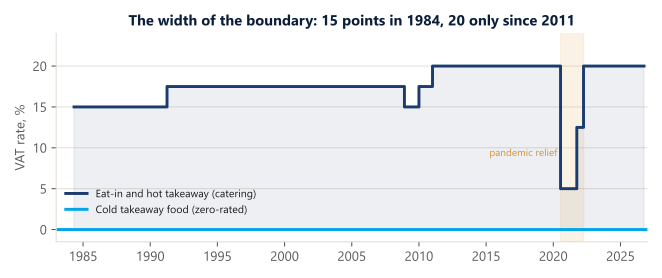
| From | Change | Eat-in / hot takeaway | Cold takeaway | Gap |
|---|---|---|---|---|
| 1 May 1984 | Hot takeaway food brought into standard rating | 15% | 0% | 15 pts |
| 1 April 1991 | Standard rate rises | 17.5% | 0% | 17.5 pts |
| 1 December 2008 | Temporary cut | 15% | 0% | 15 pts |
| 1 January 2010 | Rate restored | 17.5% | 0% | 17.5 pts |
| 4 January 2011 | Standard rate rises | 20% | 0% | 20 pts |
| 15 July 2020 | Hospitality reduced rate | 5% | 0% | 5 pts |
| 1 October 2021 | Reduced rate raised | 12.5% | 0% | 12.5 pts |
| 1 April 2022 | Standard rate restored | 20% | 0% | 20 pts |
| 25 June 2026 | Children’s meals eaten in only, to 1 September 2026 | 5% | 0% | 5 pts |
Table 1. The boundary’s width over time. The temporary reduced rate covered catering, hot takeaway food and hot non-alcoholic drinks; it did not apply to alcohol, and cold takeaway food was unaffected throughout. A further temporary 5 per cent rate applied from 25 June to 1 September 2026 to children’s meals served for eating on the premises (takeaway meals excluded), alongside admission to family attractions (Revenue and Customs Brief 5 (2026)).
The reduced-rate window matters for anyone reading accounts from those years. For roughly twenty months the state closed most of the boundary, and every operator’s VAT burden fell sharply. Comparisons of 2020–22 results with any other period are therefore comparisons across a different tax regime, and should be read that way.
3Four decision trees
One page, four questions sets, designed to be copied and kept by the till. Each runs top to bottom; stop at the first answer that applies. They describe the general structure of the rules and are not a substitute for checking a specific product.
- Will the customer eat it at tables, counters or seating you provide, or in an area set aside for eating that you share with others? YES Standard-rated, whatever the food
- Is it eaten in a place you control but not set aside for eating, such as a shop floor with no seating? YES Usually treated as takeaway; go to Tree B
- Otherwise Takeaway; go to Tree B
- Is it above room temperature when sold? NO Not hot food; go to Tree C
- Was it heated so that it could be eaten hot, heated to order, kept hot, put in heat-retaining packaging, or sold as hot? YES to any Standard-rated
- Is it simply freshly baked and cooling, with none of the above? YES Not hot food; go to Tree C
- Is it confectionery, a chocolate-covered biscuit, ice cream, crisps or a savoury snack? YES Standard-rated
- Is it a cake, or a biscuit not covered in chocolate? YES Zero-rated
- Is it a drink? YES Go to Tree D
- Otherwise ordinary food — sandwiches, salads, bread, pastries Zero-rated
- Is it hot — coffee, tea, hot chocolate? YES Standard-rated, eat-in or takeaway
- Is it a cold coffee-, tea- or cocoa-based drink to take away? YES Zero-rated
- Is it alcoholic, a soft drink, juice, smoothie or bottled water? YES Standard-rated
- Is it milk or a milk-based drink, cold and to take away? YES Zero-rated
- Is it coffee beans, ground coffee or tea for making at home? YES Zero-rated
Edge cases are many — smoothies with milk, iced coffee, protein drinks, meal deals. Where a product sits near a line, the answer depends on its composition and how it is sold, and the HMRC guidance named in each legal-status box is the place to start.
4The £10 test
The arithmetic limit is easy to state. A business whose every sale is standard-rated keeps £8.33 of each £10 the customer pays, because one-sixth of a VAT-inclusive price is the tax. A business whose every sale is zero-rated keeps the whole £10. The question that matters is where real businesses sit between the two.
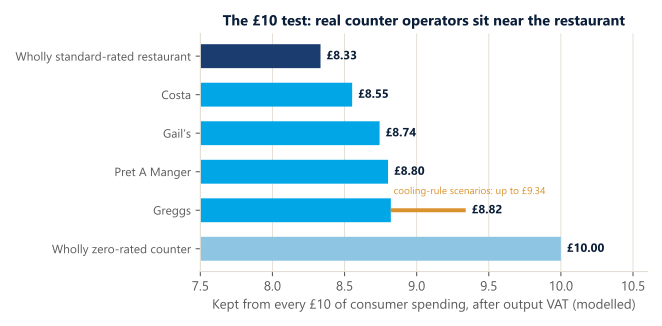
We modelled the four largest counter operators with full public accounts. For each, audited revenue is divided into streams — retail hot drinks, eat-in, hot takeaway food, cold takeaway food, packaged grocery, wholesale and franchise income — and each stream carries the rate the law applies to it. Only consumer-facing streams enter the £10 test, because VAT charged to another business is recovered by that business and burdens nobody in the chain.
| Operator · entity · year | Revenue Disclosed | Revenue mix Assumption | Kept per £10 Model output |
|---|---|---|---|
| Wholly standard-rated restaurant | — | Arithmetic | £8.33 |
| Costa · Costa Limited · FY2024 | £1,231.8m | Assumed (stated) | £8.55 |
| Gail’s · Grain Topco Limited · FY2025 | £278.0m | Wholesale share disclosed; retail split assumed | £8.74 |
| Pret A Manger · Pret A Manger (Europe) Limited · FY2025 | £704.5m | Assumed (stated) | £8.80 |
| Greggs · Greggs plc · FY2025 | £2,151.2m | Business-to-business share disclosed; retail split assumed | £8.82–£9.34 |
| Wholly zero-rated counter | — | Arithmetic | £10.00 |
Table 2. The £10 test by operator. Revenue as filed and checked by arithmetic against gross profit. Revenue is a disclosed fact. The revenue mix is an assumption except where marked disclosed (a share taken from a note to the filed accounts); every assumption is listed in the published model. Kept per £10 is a model output, not the company’s actual VAT position.
Every one of the four sits within about half a pound of the restaurant, and more than a pound away from the theoretical zero-rated counter. The reason is not mysterious. Hot drinks are standard-rated in every channel. Hot food is standard-rated. Eating in is standard-rated. What is left at zero is the cold takeaway slice, and in none of these businesses is it the majority of consumer sales.
Greggs, and the rule that decides it
Greggs is the case the cooling rule decides. Its baked savouries can be racked to cool rather than kept hot, and if they are, they are zero-rated under the 2012 tests; its hot cabinets, hot sandwiches and every hot drink are standard-rated. How much of the hot-food till is genuinely kept hot is not published anywhere, so we run it as a scenario range rather than a point.
| Scenario | Share of hot food kept hot Assumption | Kept per £10 Model output |
|---|---|---|
| All hot food treated as standard-rated (base model) | 100% | £8.82 |
| Hot cabinets, hot sandwiches and heated lines only | 35% | £9.19 |
| Cooling rule applies to all baked savouries | 10% | £9.34 |
Table 3. Greggs plc, FY2025, under three assumptions about the hot-food till. The kept-hot share is not published by Greggs and is an assumption; on public information alone the model places Greggs between £8.82 and £9.34 of every £10; where in that range the truth sits is known only to Greggs.
Even at the top of the range, the brand most people would name as Britain’s zero-rated food business keeps 66 pence less per £10 than the theoretical zero-rated counter. The folklore figure overstates the boundary’s effect on the businesses it is usually used to describe by something like three times.
The reduced-rate years
The same model shows what the pandemic relief did. With hospitality VAT at 5 per cent for most of FY2021, the model outputs are £9.45 per £10 for Greggs in that year, £9.46 for Pret, £9.42 for Costa and £9.23 for Gail’s. One caution is essential: the model holds each operator’s revenue mix constant across years, so these figures measure the change in the rate alone. In reality eat-in trade was legally suspended for months and the mix moved sharply towards takeaway, which the model does not capture by construction.
5Why the naive model is wrong, in four steps
The £10.00-against-£8.33 comparison fails for four separate reasons, each of which pulls a real business away from the zero-rated end.
1 · These are groups, not shops
A large food operator’s revenue is not one till. Costa Limited’s turnover includes its stores, franchise royalties, the Costa Express machine network, wholesale beans and supermarket packs. Greggs has company-managed shops, franchised shops and a wholesale arm. Gail’s runs a wholesale bakery. Pret sells through grocery and franchises abroad. Each stream sits in a different place relative to the boundary, and the shop counter is only one of them.
2 · Business-to-business VAT burdens nobody
Standard-rating only bites where the customer cannot recover the tax. A franchisee recovers the VAT on its royalty; a supermarket recovers the VAT on what it buys. Those streams carry VAT on the invoice but no burden in the chain, so they are excluded from the consumer test entirely.
3 · The cup and the bag are different supplies
Coffee sold as a product for home preparation — beans, ground and instant coffee — is restored to zero-rating by Schedule 8, while a cup of coffee is standard-rated as a hot drink. The same beans sit on opposite sides of the boundary depending on whether they leave the shop in a cup or a bag.
4 · VAT is a tax on value added, not on sales
Every VAT-registered business recovers the VAT on its own costs — packaging, energy, equipment, marketing, and rent where the landlord has opted to tax. A business whose sales are mostly zero-rated but whose costs carry VAT will reclaim more input tax than it charges, and is entitled to a repayment from HMRC; many such businesses file monthly for that reason. This is the ordinary mechanism of the tax, and it means the effect of the boundary on a business is the net of both sides, not the sales side alone.
Two further asymmetries follow from the input side. Packaging is standard-rated, and a counter business uses far more of it per pound of sales than a dining room, so it has more input tax to recover. And an independent restaurant buying zero-rated ingredients from third parties has almost no input tax on its largest cost line, so the 20 per cent on its sales is close to a true burden rather than a flow-through.
6The delivery stack
Delivery platforms publish more than most businesses about the money that passes through them. Deliveroo plc reported both its gross transaction value and its revenue, so its take rate can be checked rather than trusted.
| Deliveroo plc Disclosed | Gross transaction value | Revenue | Revenue as share of GTV | Gross profit as share of GTV |
|---|---|---|---|---|
| 2022 | £6,848m | £1,975m | 28.8% | 9.4% |
| 2024 | £7,433m | £2,072m | 27.9% | 10.3% |
Table 4. Deliveroo plc annual reports, group figures. In 2024 the platform handled 296 million orders at an average of £25.10. Deliveroo was acquired by DoorDash in October 2025 and Just Eat Takeaway.com by Prosus in 2025, so the public series ends there.
Two qualifications belong beside these numbers. The take rate is collected from both sides of the transaction — merchant commission, and the delivery and service fees paid by the consumer — so it is the share of the transaction the platform captures, not the share the restaurant pays. And the platform keeps only around a tenth of transaction value as gross profit: most of what it takes is consumed by riders and payment processing. The money is spent on the delivery function rather than simply retained by a middleman.
Under Deliveroo’s and Uber Eats’ published UK terms, the restaurant is the seller of the food and the platform acts as its agent, charging fees plus VAT. What makes delivery a boundary question is that a delivered hot meal is standard-rated as catering. It carries the full VAT burden and a commission on top.
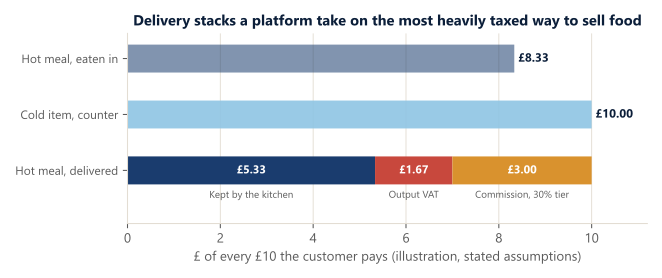
On those assumptions, of every £10 the customer pays for a delivered hot meal, roughly £5.33 reaches the kitchen. At a 25 per cent tier it is about £5.83. The same food eaten in leaves £8.33; a cold item over the counter leaves £10.00. Delivery does not merely take a share of the ticket. It takes a share of the ticket that is already the most heavily taxed way to sell the food.
7Three worked examples
Real arithmetic, invented businesses. Each example uses only the rules above and a stated sales mix; none describes any actual operator or client. All figures are per £10 of VAT-inclusive takings, after output VAT and, where stated, platform commission, and before any cost of the business.
A · A café with a takeaway counter
| Slice of takings | Share | Treatment |
|---|---|---|
| Eaten in: food and drink | 40% | Standard |
| Hot drinks to take away | 25% | Standard |
| Cold food to take away | 30% | Zero |
| Cold soft drinks to take away | 5% | Standard |
| Kept per £10 | 70% standard-rated → £10 − (£7.00 ÷ 6) = £8.83 | |
This café, which most people would describe as half takeaway, keeps the same as the largest counter chains in Table 2. Each ten points of takings that move from eating in to cold takeaway are worth about 17 pence per £10 — real, but a long way from the £1.67 the folklore implies.
B · A delivery-led kitchen
All sales are hot food, so all are standard-rated. Seventy per cent of orders arrive through platforms at a 30 per cent commission tier; thirty per cent come direct.
| Channel | Share | Kept per £10 in that channel |
|---|---|---|
| Platform orders, 30% commission | 70% | £5.33 |
| Direct orders | 30% | £8.33 |
| Blended | £6.23 |
The boundary is not this business’s main number. The channel mix is: every ten points of orders moved from platform to direct is worth about 30 pence per £10, nearly twice the café’s gain from moving ten points of trade across the VAT boundary.
C · A restaurant considering a retail line
A restaurant that is wholly standard-rated adds a counter selling bread, jars and cold goods to take home, all zero-rated food, reaching 10 per cent of takings.
| Slice of takings | Share | Kept per £10 in that slice |
|---|---|---|
| Restaurant covers | 90% | £8.33 |
| Retail line, zero-rated food | 10% | £10.00 |
| Blended | £8.50 |
Seventeen pence per £10 on the whole business, before the cost of the stock, the space and the staff time the line needs, and on the assumption that it adds sales rather than diverting them. Confectionery and soft drinks on the same shelf would be standard-rated and dilute the effect. The input tax on the retail packaging is recoverable in the ordinary way.
8The registration threshold, as forecasting
The boundary is a feature of VAT-registered businesses. A business below the registration threshold charges no VAT on any sale and recovers none on its costs; for it, the eat-in and takeaway distinction has no VAT effect at all. The threshold has been £90,000 of taxable turnover since 1 April 2024.
The useful question is therefore not how to stay below it, and this paper offers no technique for doing so, but what changes on the day a growing business crosses it — so that the change is planned rather than discovered.
- Two tests, both continuous. Registration is required if taxable turnover in the last twelve months exceeds the threshold, or if it is expected to exceed it in the next thirty days alone. Both are checked month by month.
- The price question arrives at once. Consumer prices include VAT. On registration, a business either holds its prices and absorbs one-sixth of its standard-rated takings, or raises them. For a café of type A above, holding prices means giving up about £1.17 of every £10 overnight.
- The mix starts to matter. From registration, the split between eat-in, hot takeaway and cold takeaway becomes a number on every return, and till systems need to record it correctly from day one.
- Input tax becomes recoverable. VAT on equipment, packaging, energy and, where applicable, rent can be reclaimed — which partly offsets the output side and is the reason the net effect is smaller than the headline rate.
9Questions to bring to your accountant
None of these has a general answer. Each has a specific one for a specific business, and that is what the conversation is for.
- What is our actual blended VAT rate on takings — not the headline 20 per cent, but standard-rated sales as a share of the whole?
- Does our till record eat-in and takeaway, hot and cold, at the point of sale, and does the return reconcile to it?
- Are any of our products near a line — warm bakery items, smoothies, meal deals, snacks — and is the treatment we apply documented?
- Do our seating, pavement tables or shared areas bring takeaway sales inside the catering rules?
- How much input tax are we recovering, and are we recovering all of it — packaging, energy, equipment, rent?
- What does each delivery channel actually leave us per £10 after VAT and commission, and how does that compare with direct orders?
- If we are approaching the registration threshold, what happens to our prices and margins on the day we cross it?
- Would a retail line, a menu change or a change of format alter our rate materially, once the costs of doing it are counted?
10What this paper cannot say
- Any company’s actual VAT. No company discloses the VAT it collects. Every chain figure here is modelled from audited revenue and stated assumptions about the mix of sales.
- Anything about a particular product or business. The rules are applied product by product and fact by fact; the decision trees describe the structure, not a ruling.
- That the boundary causes businesses to choose a format. Paper 1 tested that proposition against the London company register and did not find it supported: formation patterns of the same shape appear in sectors with no food VAT boundary at all.
- What the rules should be. This paper describes the law and its arithmetic. It makes no case for changing either.
StandingSources, method and disclosures
- Law
- Value Added Tax Act 1994, Schedule 8, Group 1 and Notes; HMRC VAT Notice 709/1 Catering and take-away food; HMRC VAT Notice 701/14 Food products; HMRC VAT Food manual (VFOOD); HMRC VAT Notice 700/1; Finance Act 1984; Finance Act 2012, the hot-food amendments; the hospitality reduced-rate orders of 2020 and 2021; House of Commons Library, VAT: rates. Law stated as at 1 October 2026.
- Accounts
- Filed annual accounts at Companies House: Costa Limited; Greggs plc; Pret A Manger (Europe) Limited; Grain Topco Limited and Bread Holdings Limited (Gail’s). Deliveroo plc annual reports 2022 and 2024. Revenue read from the filed pages and checked by arithmetic.
- Model
- Revenue divided into streams; each stream assigned its legal rate; consumer-facing streams only in the £10 test; mix held constant across years by construction. Streams labelled disclosed where taken from a note to the accounts and assumed otherwise; the treatment of Costa Express machine income as business-to-business, and the input-side cost shares, are stated assumptions. The model and every assumption are published with the pipeline.
- Review
- VAT treatment checked question by question against primary sources — legislation, HMRC notices and manuals, and published terms — on 1 October 2026; the worksheet and source extracts are retained.
- AI use
- This research is human-directed and AI-assisted. Roseworth Research originated and directed the study and set its questions, scope, sources, evidential standards, confidentiality rules and publication criteria. Claude (Anthropic) was used extensively as a research, software-engineering, analytical and drafting tool under Roseworth’s direction and review. Every claim derives from public data, published code, reconciliation and documented review. Roseworth Limited is responsible for the publication and any errors. Claude is not an author, and Anthropic did not review, commission or endorse the research.
- Interest
- Roseworth acts for businesses in this sector and has a commercial interest in the subject. No client data of any kind appears in this paper; the worked examples are invented.
- Standing
- Roseworth Limited is a licensed, supervised and professionally insured accountancy practice. This paper is general information and not advice; the VAT position of any business depends on its own facts.